Divide and conquer. I organized the design team into workstreams to tackle several opportunities at once: two senior designers focused on the Air Check web experience, key insights went to the SEO team and Customer Insights team, and my IBM contractor partnered with the Store Experience team on future-state hand-held device concepts — while I supported the Air Check POC and oversaw design strategy across every track.
Case Study — Discovery & Proof of Concept
Air Pressure Check
A free service completed 15 million times a year — reimagined by starting with why so much of that potential was going untapped.
With Erica Parra (Asst. UXR Manager), Josh Surridge (Product Specialist), Carolina Lagarda & Maritza Gonzalez (Senior UX Designers), and Greg Vagen (IBM UX Design Contractor).
15M+
Air Checks completed annually across every store — a free, drive-through tire inspection
4:18
average time per check, with 36 seconds spent just collecting customer information
~45%
of customer email addresses were being captured accurately in the lane
Interim Solution
Air Check Training Video
While the fully integrated solution moved through the business case, we shipped a training video as an interim fix to standardize how employees introduce the Air Check service to customers. I created the shot list, directed, and edited the video from a script provided to me.
Aircheck Pilot Instructional Video (3:11) — shot list, direction, and edit by Stephanie McNicol.
Phase 1
Discovery
Air Check drives tire sales and strengthens customer trust through a safety-first experience — but it created real friction for both customers and employees. Associates manually collected customer information, data accuracy was inconsistent, and customers lacked self-service tools like pre-check-in and service history access. Before designing anything, I led the end-to-end Discovery phase to understand why a service this successful still had so much untapped potential.
Research Approach
Over six weeks, I partnered with UX Research on a mixed-method approach:
In-store observations and contextual inquiries at three locations (Goodyear, Scottsdale, and Phoenix, AZ) — watching the lane in real time and speaking with employees and customers during service.
Employee interviews across four regions, exploring how demand, store layout, and best-practice adherence varied.
Customer diary study with 11 participants across the country, capturing the experience from awareness through post-visit follow-up.
Competitive analysis of queue management and demand visualization from Dutch Bros, Chick-fil-A, Jiffy Lube, and HonorHealth.
Service blueprinting and journey mapping, connecting the front-stage customer experience to back-stage operations.
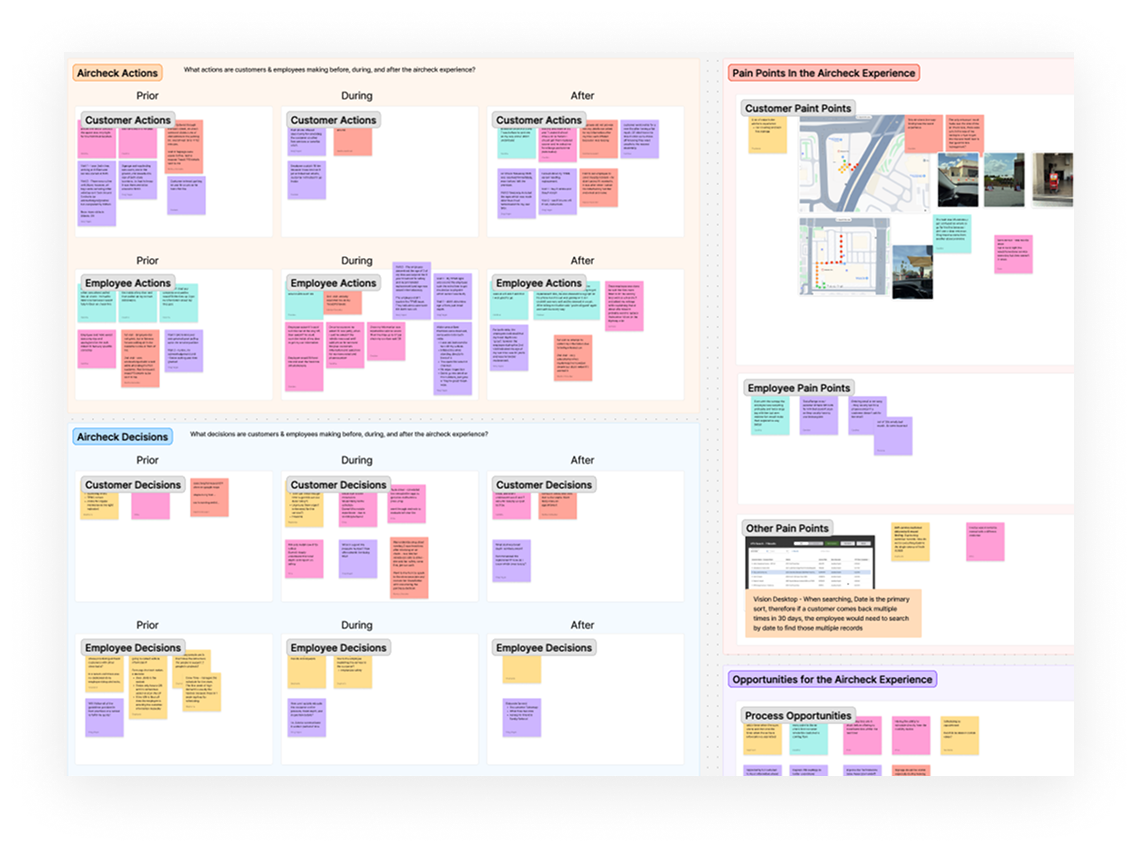
Synthesis in progress — organizing six weeks of research into themes for the Discovery report.
Key Findings
What the research surfaced
Consistent themes emerged across customer and employee perspectives, organized around four areas.
Awareness & Findability
“You know, I've never been a customer of Discount Tire up until this point. So I do appreciate that this service is available. And it's something that I actually didn't know necessarily existed. So I think overall, it was a very, very good experience.” — Max D., 25, Chicago, IL
9 of 12 customers checked Google Maps first
Store listings didn't show Air Check as an available service, so customers found it through assumption rather than design.
Many customers weren't confident the service existed — some called ahead to confirm before visiting.
There was no dedicated landing page or SEO strategy for Air Check.
In-Lane Experience
~45% of emails captured accurately
4:18 avg. check time, 0:36 on data entry
Wayfinding varied significantly by store — most weren't originally built with an Air Check lane in mind, and signage was inconsistent.
Employees captured email and phone numbers manually on hand-held devices, with recurring data accuracy issues.
Seasonal and weather-driven demand spikes created real pressure on the lane, with no predictive scheduling or real-time queue visibility.
Post-Visit Communications
~50% never received the takeaway email
89% rated it very useful when they did
2–3% SMS opt-in rate
Of diary study participants who received the post-visit takeaway, 80% were likely to act on it via the included link.
Low SMS opt-in was partly explained by the opt-in moment coming too late in the flow.
Customers wanted personalized tire recommendations, pricing guidance, and easier appointment booking — not just a status report.
Employee Perspective
68% national device usage rate
20–80+ Air Checks/day, by store volume
Employees at high- and low-volume stores described very different daily realities.
The best-performing stores had shifted from "checking air" to "safety inspection" framing — a mindset change that measurably shaped how employees communicated with customers.
Hand-held devices for scanning tread depth and capturing customer info were used in only about 68% of Air Checks nationally.
Deliverables
From synthesis to executive alignment
At the end of Discovery, I produced four deliverables for executive review, then organized the design team into workstreams to act on them.
Discovery Report
A comprehensive synthesis of findings, organized around three opportunity areas: Awareness, In-Lane Service, and Post-Visit.
Future-State Narrative
A scenario walkthrough showing how an improved, connected Air Check experience would feel for customers and employees — used to align execs on direction.
Journey Map & Service Blueprint
Mapping touchpoints, pain points, and back-stage dependencies across the full Air Check lifecycle.
Competitive Analysis
Benchmarking queue management and demand visualization from adjacent industries to inspire the solution space.
Phase 2
Proof of Concept
One of the clearest opportunities from Discovery was the 36 seconds spent manually collecting customer information at the lane. The hypothesis: a QR code sign at the queue entrance could let customers self-submit their details before reaching the employee — reducing friction, improving data accuracy, and freeing employees to focus on the inspection itself. My role shifted to UX support as the team designed and ran the test, contributing to the customer-facing experience and shaping how we measured success.
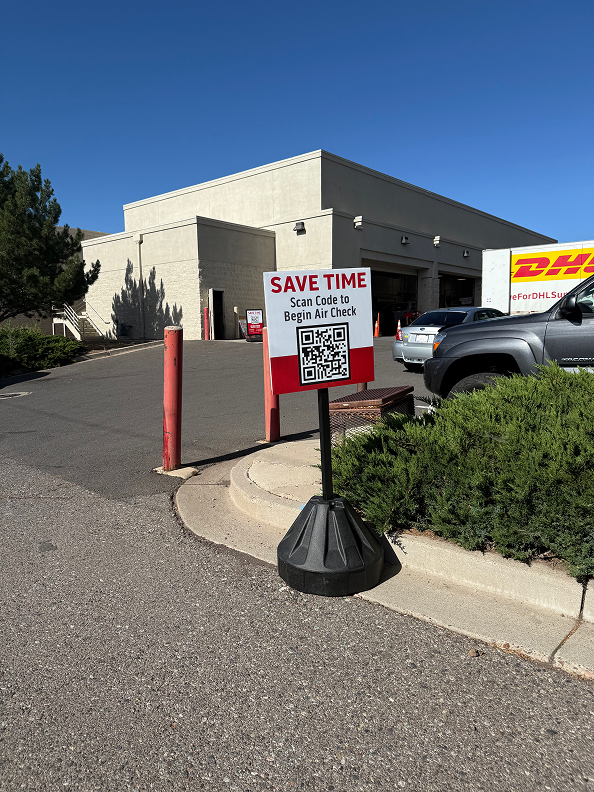
The QR code sign piloted at the Air Check lane entrance across ten store locations.
How It Worked
Weighted bollard signs with QR codes placed across ten locations (one pilot store plus nine test stores) in Washington, Texas, and Arizona.
Scanning took customers to a short Alchemer form to submit name, contact details, and vehicle information before reaching the employee.
Stores were chosen to represent a range of demand levels, lane layouts, and regions, with up to three signs per store depending on queue setup.
Store managers joined a 30-minute kickoff call and a mid-pilot check-in, with metrics tracked weekly across a two-week window.
Results
“The biggest takeaway and benefit — it needed a little bit of a coachable moment with some of my people doing their checks, but was the understanding that they take that information and verify what we had. We found that we had a lot of inaccurate data on our VTV devices.” — Roux, Store Manager, WAS21 (POC)
+26pp email capture at the top store
−34pp bad email inputs at that store
+17pp mileage capture at another top store
36% adoption vs. Zebra scans
27% adoption vs. Haltec inflations
Adoption correlated strongly with demand level and how consistently employees encouraged customers to scan. Qualitative feedback from employees and customers was broadly positive — employees saw potential for efficiency gains in a fully integrated solution, and customers responded better to messaging about time savings than about data collection.
What We Learned
Store demand was the biggest predictor of adoption — high-volume stores saw higher scan rates, likely because the wait made the QR code feel worthwhile.
Android users experienced slower QR load times than iOS users, a UX consideration for any future integrated solution.
About 20% of Air Check customers in the two-week window were repeat visitors, and the form wasn't optimized for them.
The form confirmation screen turned out to help employees verify and correct customer data on the spot.
A "Save Time" CTA motivated customers more than messaging about data collection — an important framing insight for any future rollout.
Outcomes & Next Steps
The business case for full rollout
$10M–$23M
in projected incremental revenue if a fully integrated QR check-in experience rolled out across all of Discount Tire's 1,200+ stores.
$1.80 → $1.64
cost-to-serve per vehicle, at a projected 60% adoption rate
The Discovery report and POC results together built the business case for integrating QR check-in directly into the hand-held device — pre-populating vehicle data and queuing customers before they even reach the lane. Beyond the tactical outcome, this project reinforced how much design can accomplish by working across the full customer journey rather than optimizing a single moment in the lane.