Success Metrics
Case Study — Mobile Booking Redesign
Service Appointments
Redesigning Discount Tire's mobile appointment flow to match how customers actually think — vehicle first, everything else after.
72.83%
completion rate at the date/time selection step — the lowest point in the funnel
1 in 3
appointments resulted in a no-show, pointing to a confidence and expectations problem
94% vs 89%
completion for customers who entered vehicle info first, versus those who didn't
The Challenge
Solid on desktop, friction on mobile
Service appointments are one of Discount Tire's strongest revenue drivers, but the mobile booking flow saw meaningful drop-off — particularly at date and time selection, and among users without a saved vehicle. Research suggested the flow wasn't matching how customers actually thought about the task.
“How might we redesign the appointment flow to better match customer mental models while improving clarity, efficiency, and conversion?”
Date/time completion +3%
Vehicle fitment completion +5%
Overall completion +3–5%
Research
Three phases
Phase 01
Exploration
We evaluated appointment booking experiences across industries and analyzed the existing flow with ContentSquare to identify friction points and establish a behavioral baseline.
Phase 02
Flow A vs. Flow B
The biggest open question was step order. Through unmoderated mobile usability testing, we compared a vehicle-first flow against a service-first flow — customers strongly preferred entering their vehicle first, expecting personalized service options and pricing in return.
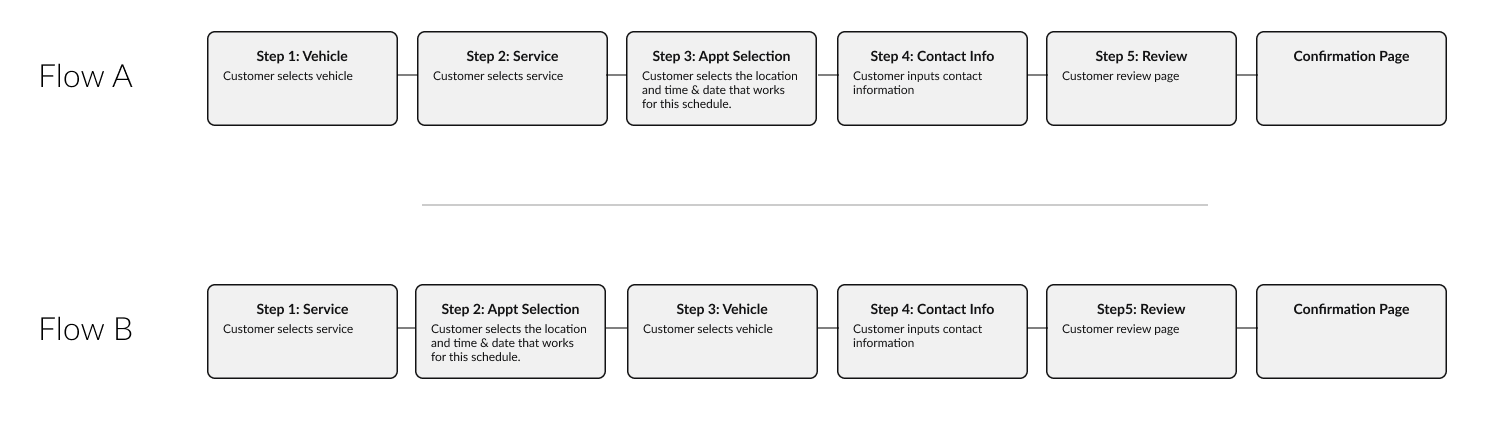
Flow A (service-first) vs. Flow B (vehicle-first) — the comparison that shaped the final direction.
Phase 03
Ideate & Refine
With the flow direction validated, we tested a refined prototype, surveyed existing customers, and analyzed funnel data to uncover remaining friction before moving into detailed design.
Key Findings
What customers told us
Customers expected personalized service recommendations in exchange for vehicle information — a vehicle-first flow felt more intuitive.
Clear service descriptions, icons, and categories helped non-expert users choose services with more confidence.
Availability mattered more than location — users were willing to travel up to 10 miles farther for a preferred time slot.
Sticky CTAs and clearer navigation improved progression through the flow.
6.3/7
user satisfaction score on the final concept — enough confidence to move forward into detailed design.
The Solution
Designed around the friction points
The final concept addressed each major friction point identified through research.
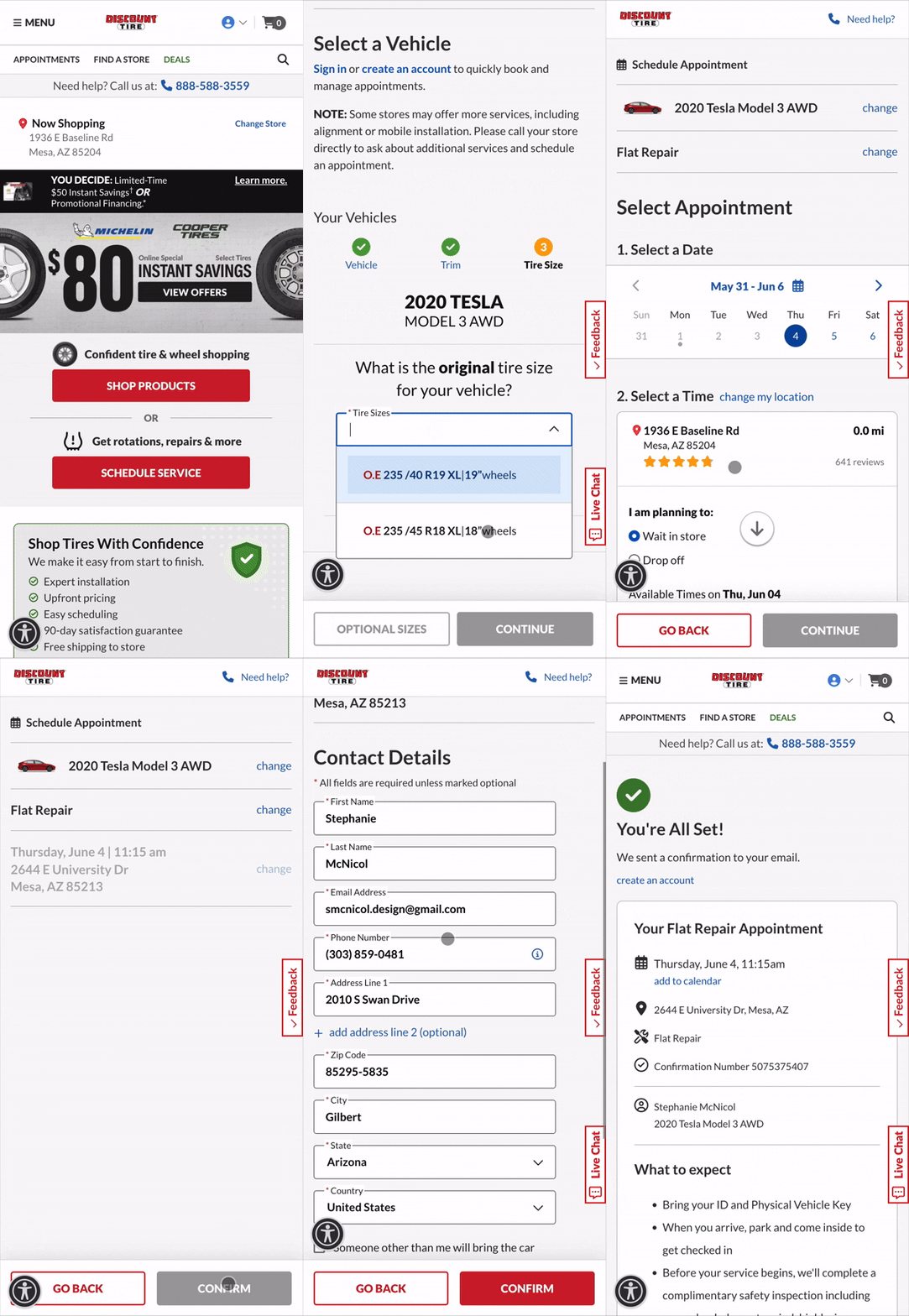
The final vehicle-first booking flow, from vehicle entry through confirmation.
01
Vehicle-first flow
Starting with vehicle selection created a more intuitive booking experience, matching how customers already thought about the task.
02
Simplified service selection
Clear categories, icons, and plain-language descriptions helped customers confidently choose services without expert knowledge.
03
Combined location & time
Bringing store and appointment availability into a single step reflected how customers naturally prioritized booking decisions.
04
Sticky CTAs
Persistent action buttons made it easier to navigate the flow and reduced confusion during booking.
Outcome
Validated in production
$11M
in annualized revenue generated by the vehicle-first flow, validated through an A/B test and implemented in production.
+4.7%
date/time step completion, six months post-launch
+12.2%
appointments completed with vehicle fitment
+7.2%
overall appointment completion rate