Waitlist Experience
Bringing visibility and predictability to a walk-in-first business — so customers know how long they'll wait, and stores know who's coming.
Three friction points
Before designing anything, we needed to understand the shape of the problem. These three friction points came up consistently across research and store operations.
Lost in the Lobby
During busy periods, physical queues were difficult to manage. Customers could be overlooked or lose their place in line, while employees juggled queue management alongside service.
The Wait Time Blindspot
There was no reliable way to track when walk-in customers entered the queue, making wait times inaccurate and limiting visibility into demand and staffing needs.
Lack of Transparency
Customers had no real-time view of their place in line or expected wait, making it difficult to plan and increasing the likelihood of frustration or abandonment.
From Head to Store Now to Digital Walk-In
Digital Walk-In builds on the learnings from Head to Store Now (HTSN), an earlier pilot in the Texas region that let customers notify a store before arriving. Research showed that proactive communication — including service tracking and direct store contact — increased customer confidence, particularly for urgent service needs when appointments weren't available.
However, HTSN struggled with discoverability and required several unintuitive steps. While it helped customers feel prioritized, it did little to improve queue visibility for store employees.
Digital Walk-In keeps what worked while reimagining the experience for greater transparency on both sides of the counter.
HTSN's click-through rate — the discoverability problem Digital Walk-In was designed to solve.
Competitive review and mental models
To inform the design, we evaluated nine waitlist experiences across industries and interviewed 12 participants to understand what made customers feel informed, in control, and confident while waiting.
“I like that it showed how many vehicles are in front of you. I think that's more valuable than time. You have the estimate, which is great, but you also know practically how many cars are in front of you.” — Kimberly S., research participant
Queue position mattered more than time estimates. Customers valued seeing how many people were ahead of them, not just an estimated wait.
Communication built trust. Text updates were the primary way customers stayed informed and felt confident in the process.
Predictability mattered more than speed. Consistent wait estimates reduced anxiety and helped customers plan their arrival.
Clear instructions improved confidence. Customers wanted to know where to go, when to arrive, and what would happen next.
Employee insights
Through in-person and remote research with employees at Texas beta locations, we found strong support for Digital Walk-In and its potential to improve both customer experience and store operations. The biggest concerns were wait time accuracy, training readiness, and system complexity — a theme that held across sessions: successful adoption depended more on effective training than launch speed.
Design across four channels
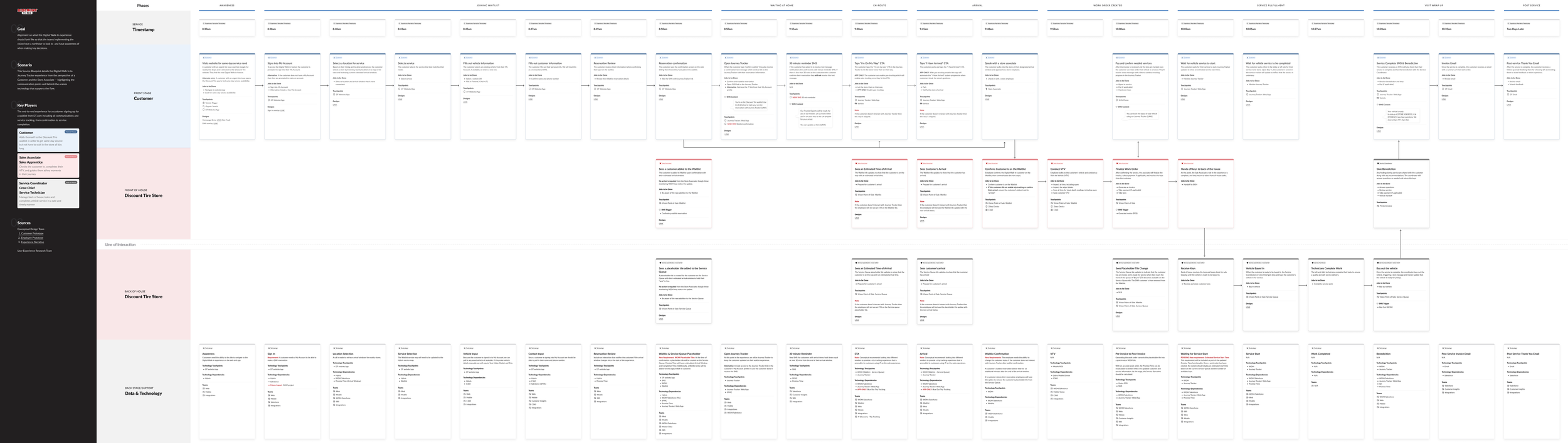
Digital Walk-In spanned four touchpoints, each designed to support a different part of the experience. The service blueprint below was key to aligning every channel to one consistent journey.
Join with minimal friction
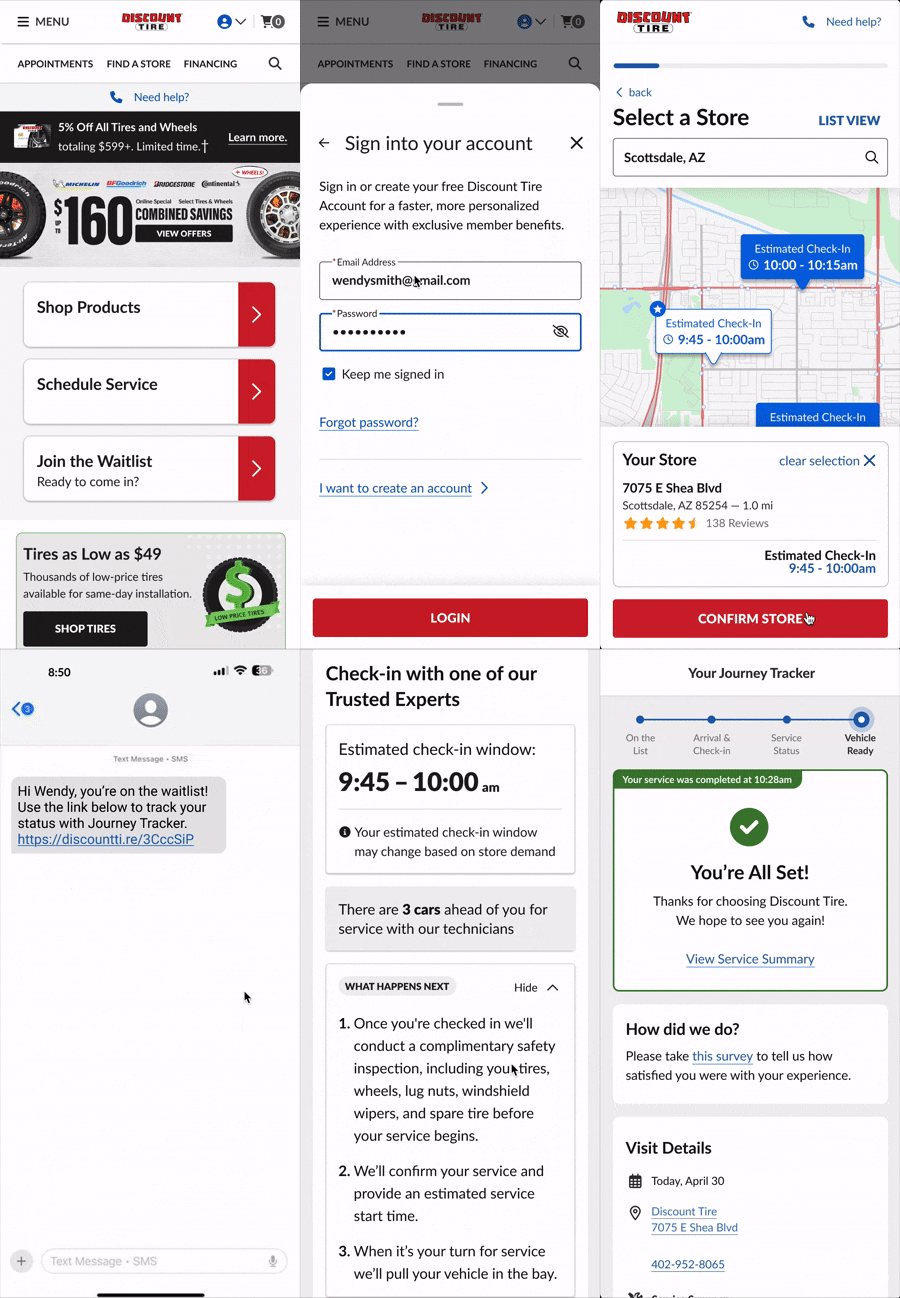
Customers could view wait times, assess store availability, and join the waitlist in a few taps. Once enrolled, a service tracker link gave visibility into queue status and next steps.
Structured queue for teams
The Customer Service List reserved a customer's place before arrival, improving demand visibility and wait time tracking — plus new no-show, filtering, and search tools for busy queues.
Proactive, not constant
Research showed customers wanted proactive updates, not constant monitoring. Automated texts delivered confirmation, queue updates, and arrival reminders.
Validation
Prototype testing with 12 participants showed strong results, and analytics modeling pointed to meaningful business impact once launched.
Employee feedback validated the concept and reinforced three priorities for launch: